
What Yin and Yang Mean
Yin and Yang are often described as opposites, but that description alone is incomplete. They do show contrast, but they also show connection.
Rather than treating things as fixed and separate, Yin and Yang help explain how different qualities exist in relation to each other. One side becomes clearer when compared with the other.
In simple terms, Yin and Yang describe paired tendencies such as inward and outward, stillness and movement, or contraction and expansion. These are not absolute categories. They are ways of observing relationship and change.
The Yin and Yang Symbol and the Idea of Change
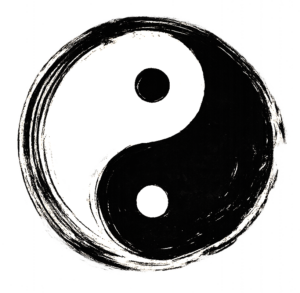
At first glance, the symbol may appear to show two opposite halves. More accurately, it shows continuous movement. The black and white shapes curve into each other, suggesting an ongoing cycle rather than a fixed division.
The white area represents Yang, and the black area represents Yin. The small black dot inside the white area suggests that Yin begins to appear when Yang reaches its fullest point. The small white dot inside the black area suggests that Yang begins to appear when Yin reaches its fullest point.
This expresses an important idea: when something reaches an extreme, the beginning of change is already present.
The curved form of the symbol also suggests direction. One side expands, while the other returns inward. This movement helps illustrate that Yin and Yang are not static. They describe change as an ongoing process.
Yin and Yang as a Way to Understand Relationship
Yin and Yang are relational. Something is understood as Yin or Yang depending on context, function, and comparison.
For that reason, Yin and Yang should not be treated as rigid labels. The same thing may be described differently depending on what it is being compared with. What matters is not the label by itself, but the relationship being observed.
This is why Yin and Yang are useful as a basic framework. They help organize patterns of movement, contrast, and balance without reducing everything to simple categories.
Examples of Yin and Yang in Everyday Life
The idea becomes easier to understand when seen in ordinary life.
Common examples include:
- day and night
- summer and winter
- activity and rest
- inside and outside
- expansion and contraction
These examples show contrasting tendencies within one larger whole. Day changes into night. Activity gives way to rest. Warm conditions shift toward cold, and cold conditions eventually shift again.
By observing these kinds of changes in daily life, the idea of Yin and Yang becomes easier to understand in practical terms.
Why Yin and Yang Matter in Birth Code
In Birth Code, Yin and Yang provide one of the most basic ways to understand how energy is expressed. They help describe whether a quality tends to move outward or inward, rise or descend, expand or contract.
This becomes especially helpful when studying later topics such as the Five Elements, the Heavenly Stems, and the Earthly Branches. A basic understanding of Yin and Yang makes those ideas easier to follow.
For convenience, Yin is often shown as (-), and Yang is often shown as (+). These symbols are only simplified markers, but they can help beginners read charts and explanations more easily.
Yin and Yang are best understood as a way of observing change and relationship. Once that basic idea is clear, the rest of the structure becomes easier to understand.