What Is Birth Code?
Known as Bazi in China and Saju in Korea, this system is often referred to in English as the Four Pillars of Destiny. In this book, we will use Birth Code as a simple and beginner-friendly name for the system, and Birth Code chart for the chart itself.
Birth Code is a traditional system that uses the moment of birth to understand patterns of energy and structure in life. It developed from an older way of observing time, rooted in ancient astronomical observation. In simple terms, it is a method of reading life through the time a person is born.
Every person is born at a specific year, month, day, and hour. In Birth Code, that moment is not treated as just a date. It is understood as structured time. The system takes that birth moment and organizes it into four parts, known as the Four Pillars.
In Korean tradition, this birth moment is sometimes understood as the point at which a person’s life begins in relation to the larger order of the universe. For beginners, this can be understood more simply as the starting pattern a person is born with.
Birth as Structured Information
Birth Code comes from a concept of time based on ancient astronomical observation. This means time is not random. It follows patterns and cycles. Because of this, your birth moment can be translated into a structured system.
The system converts your birth time into four parts:
- Year
- Month
- Day
- Hour
These are called the Four Pillars.
Each pillar has two parts:
- Heavenly Stem
- Earthly Branch
Together, they form eight characters.
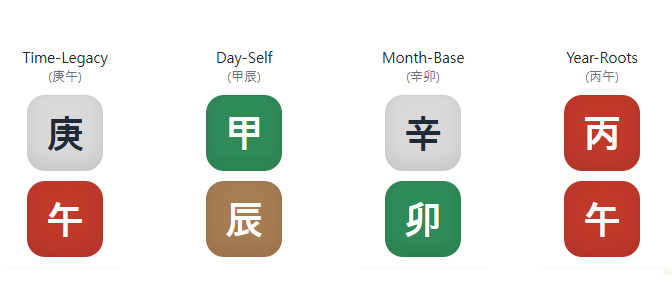
This is why the system is also called the “Four Pillars and Eight Characters” or the “Four Pillars of Destiny.” In this book, we will refer to it as the “Birth Code Chart.”
Each pillar is made of two parts: a Heavenly Stem and an Earthly Branch. Together, they form a chart of eight characters, often referred to as the “Four Pillars and Eight Characters” (四柱八子). In this book, we will refer to this as the “Birth Code Chart.”
These symbols are not random. They follow a fixed order and repeat in cycles, reflecting patterns of time. For this reason, the Birth Code system does not treat birth as a simple set of numbers. Instead, it presents birth as a structured pattern.
Birth Code (Saju) in Korean Culture
In Korea, Birth Code has long been part of the cultural background surrounding how people think about life. Historically, it developed within a broader East Asian worldview that also included ideas such as Yin and Yang, the Five Elements, physiognomy, and feng shui. In everyday life, these were often understood together as different ways of thinking about balance, timing, character, and environment.
Birth Code was also connected to important life events. In more traditional settings, families sometimes exchanged birth information when discussing marriage and used it as one way to consider compatibility. It was also commonly referenced when choosing meaningful dates, thinking about personality, or reflecting on life direction.
Not everyone studied the theory in detail or treated it in the same way. Some saw it as a living tradition, while others viewed it more as a cultural habit or a tool for reflection. Some dismissed it as superstition, but still recognized its place in Korean culture.
For that reason, Birth Code is best understood not only as a traditional system of interpretation, but also as part of Korea’s long cultural memory.
It developed alongside other traditional ideas such as:
- Yin and Yang
- The Five Elements
- Feng Shui
- Physiognomy
These systems were not always separated.
They were often used together to understand balance, timing, and life direction.
How It Was Used in Daily Life
In more traditional settings, Birth Code was part of everyday decisions.
For example:
- Marriage compatibility
- Choosing important dates
- Understanding personality
- Reflecting on life direction
It was not always used in a strict or technical way. Some people studied it deeply. Others treated it as a cultural reference. Some dismissed it entirely.
But even then, it remained present.
What a Birth Code Chart Shows
A Birth Code chart shows how energy is arranged at the moment of birth.
It presents a structured pattern that forms the foundation of the chart. Rather than listing separate parts without connection, it shows how each part is placed within a larger system and how those parts relate to one another.
In simple terms, the chart shows arrangement, connection, and balance. Each part gains meaning through its position and its relationship with the rest of the chart.
You can think of the chart as a map. A map shows the layout of a place before it helps you understand movement within it. In the same way, a Birth Code chart shows the layout of energy first, creating a clear starting point for interpretation.