
Understanding the Basic Structure of the Chart
Once your chart has been generated, the next step is to understand its basic structure. A Saju chart is organized into four parts, known as the Four Pillars: the Year, Month, Day, and Hour. Together, these pillars describe the structure of your birth moment.
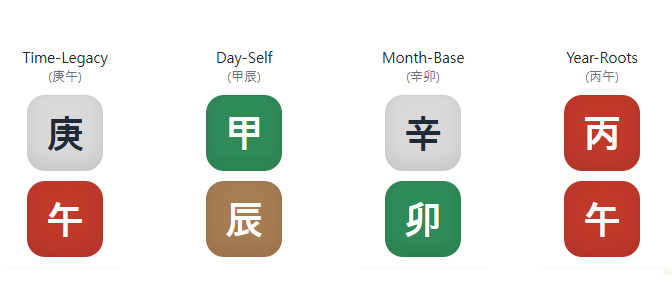
Each pillar is often associated with a different layer of life. The Year Pillar is commonly linked to the broader environment and early influences. The Month Pillar is often connected with growth, development, and surrounding conditions. The Day Pillar is usually treated as the center of the chart, and the Hour Pillar is often associated with later development, inner life, or future-oriented aspects.
Among the four, the Day Pillar holds special importance because its Heavenly Stem represents you. This is called the Day Master. For this reason, the Day Pillar becomes the main reference point when reading the rest of the chart, since other elements are often understood in relation to it.
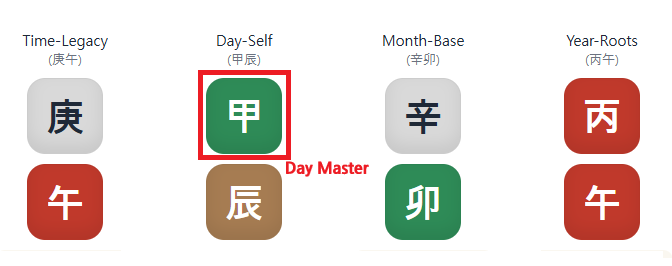
The Four Pillars can also be viewed from different perspectives. Some readers see them as stages of life, while others understand them as different relational layers. For example, the Year may be associated with ancestry or background, the Month with family or environment, the Day with the self, and the Hour with future expression.
These meanings are not fixed. They are simply different ways of approaching the same structure. This means a chart does not have only one interpretation. Instead, it can be understood from multiple angles, depending on what you are focusing on.
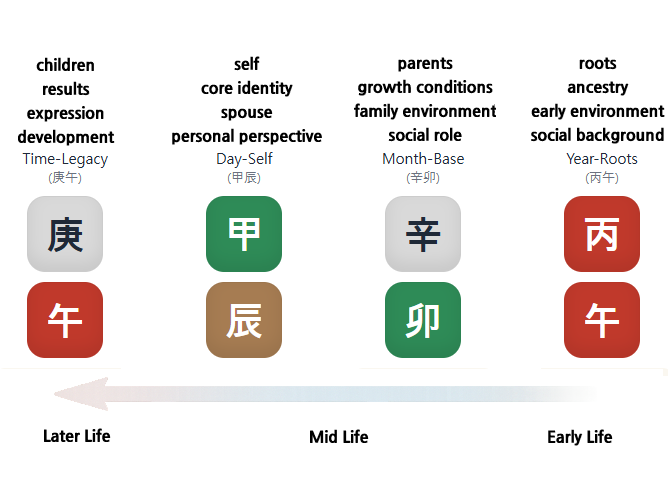
In simple terms, the structure stays the same, but the way you look at it can change. This flexibility is an important feature of Saju.
Each pillar has a position. Each position has a role. Together, they form a structured system rather than a collection of separate parts.
One-Line Summary
The Four Pillars are a structured framework of time that organizes the chart, with the Day Pillar as the central reference point.